















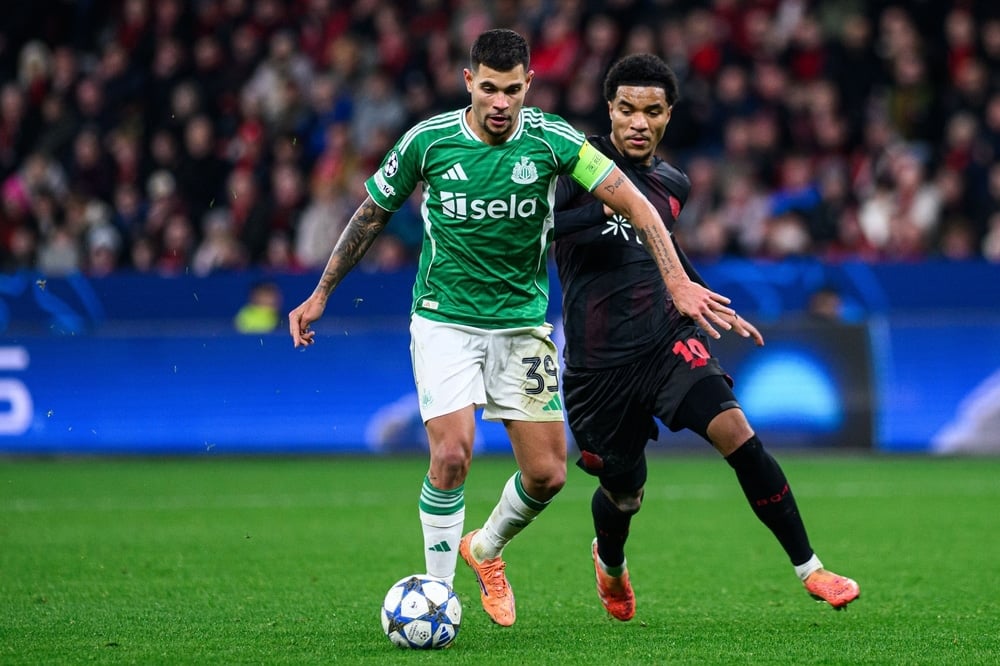
Regardless of your stance on the November international break, one reality remains undeniable: it arrives at an ideal time for analytical football enthusiasts. A ten-game sample size provides genuinely useful insights. At this juncture, many squads closely resemble what their underlying data suggests they are. A similar principle applies to individual athletes. While fewer players have crossed the 900-minute threshold, a large portion has surpassed 500 minutes on the pitch, establishing a reliable body of evidence largely immune to the distortion of a single exceptional or disastrous performance.
Definitive conclusions may still be premature, but the data opens the door to fascinating tactical queries. Here are five major questions sparked by player performances thus far:
1. Assessing Bruno Guimaraes and His Role at Arsenal
Investing a massive sum in a player approaching their late twenties usually brings immediate expectations. This is especially true for Bruno Guimaraes, a former Newcastle United standout who routinely terrorized Premier League midfields and looked ready for a Champions League contender. While his current form is hardly a crisis for league-leading Arsenal, the Brazilian midfielder has not exploded out of the gate. Mikel Arteta has echoed this sentiment openly, even following otherwise strong showings like the match against Hull City.
“He’s hitting serious levels now, but we can still take him to another level. That’s my conviction; I told him that in the dressing room — he owned a lot of moments in the game, but there is still much more to come.” Aside from his outings against Hull, his most impactful moments have arguably come as a substitute. When entering from the bench, he records higher passing accuracy, wins more tackles, generates scoring chances, and nets spectacular goals. When named to the starting lineup, however, he has occasionally appeared out of sync with his peers.
Physical metrics supplied by Gradient Sports offer potential clues regarding this adjustment period. Across every 90 minutes of Premier League action, Guimaraes covers less distance at high sprint speeds (≥25 km/h) than any outfield teammate aside from Mikel Merino, while spending a significantly higher amount of time jogging—averaging roughly 30 minutes per match. When contrasted with a relentless engine like Declan Rice, the discrepancy in pace becomes much more apparent.
This also clarifies why he excels so brilliantly as a substitute. Once opposing players begin to tire around him, Guimaraes’s physical limitations are masked, allowing him to dictate the tempo of the match.
While this dynamic works for the short term, it is unsustainable moving forward. Myles Lewis-Skelly will eventually need to make room in the XI, even though the academy graduate’s emergence helped unlock a higher level of performance from Declan Rice toward the end of the previous campaign. A club-record marquee signing cannot permanently serve as an impact substitute behind a teenager. Even so, if any squad can successfully lean into the concept of a high-profile game-changer off the bench, it is Arsenal, a club that thrives on late-game contributions.
2. Thierno Barry’s Breakout Campaign with Everton
Erling Haaland’s dominant grip on the Premier League expected goals (xG) leaderboard has faced an unexpected challenger. Not since the days of Romelu Lukaku has an Everton centre-forward looked this threatening in front of goal. Only once since the Belgian’s departure has an Toffees player breached the 20-goal mark across all competitions, with double digits proving elusive over the last five seasons.
Thierno Barry has not reached that milestone yet, but his trajectory points firmly upward. His non-penalty expected goals (npxG) mark of 7.28 places him just ahead of Haaland and nearly 2.5 npxG clear of any other player in the English top flight. Looking across Europe’s top five leagues, he trails only Lamine Yamal, Donyell Malen, Raphinha, and Kylian Mbappe—all of whom benefit from playing for dominant continental giants rather than an upper-midtable side in the most demanding league in Europe. Within that challenging environment, Barry continues to excel at the hardest part of the game: finding premium shooting locations consistently.
Had Barry converted his opportunities at the exact rate he generates them, Everton might sit even higher than sixth in the standings. Even so, securing six goals through his first ten appearances is an impressive feat, especially given the immense pressure on the 24-year-old. Following a botched deadline-day pursuit of Folarin Balogun and Beto’s departure to Fiorentina, David Moyes had little choice but to rely heavily on Barry.
That enforced show of confidence appears to have unlocked the former Villarreal attacker, who experienced an inconsistent debut season in England. His manager points to smoother integration off the pitch as the catalyst. “He has settled down a bit more,” Moyes remarked following Barry’s decisive brace against Coventry. “His language, his understanding, his communication is much better and he has worked hard to get himself in those positions to score.”
It is easy to understand why off-field adaptation was the missing puzzle piece. Barry possesses the ideal physical traits for the modern English game: tall, physically imposing, and mobile, ranking among the top center-forwards for pure speed this season according to Gradient Sports. He functions as a reliable outlet to bypass defensive presses while possessing the aerial and positional awareness to crash the penalty area. He may lack the aesthetic flair of an Mbappe, but his ability to command valuable space pays massive dividends, as demonstrated when a long-range strike from James Tarkowski deflected off him into the net. This is what modern elite forward play looks like, and Everton will hope this form persists.
3. Alex Iwobi’s Evolution Into a Creative Force at Fulham
Underrated footballers generally fall into a few distinct categories. First, there are traditional unsung heroes, often found anchoring mid-table sides—players who quietly post elite expected assist figures during a standout campaign. Then there are those labeled underrated so frequently that public perception flips, turning them into household names.
Rarer still is the chameleonic player whose role shifts entirely, rendering them underrated in a completely new way. Consider Alex Iwobi. For years, the consensus around the Nigeria international framed him as a solid, dependable squad option for clubs hovering around the lower-to-middle tier of the Premier League.
Those evaluations are outdated. Ten matches into the current campaign, Iwobi has established himself as one of the premier creative engines in the division, playing a pivotal role in Fulham’s upward momentum following a sluggish start under Alvaro Arbeloa.
Among true playmakers, Iwobi excels at delivering the ball into dangerous zones and fashioning opportunities for his teammates. He leads the league in expected assists with 2.95 and shares the top spot with Bruno Fernandes for passes completed directly into the penalty box. Only Pascal Gross has generated more overall chances.
Furthermore, those rivals struggle to match Iwobi’s proficiency in progression. Operating primarily from the left-inner channel as Fulham’s primary distributor, he has completed more progressive ball-advances from deep areas than anyone outside of Declan Rice and Jan Paul van Hecke.
When Iwobi first burst onto the scene at Arsenal, he showcased a natural instinct for keeping attacking sequences alive through intelligent preliminary passing. Now 30 years old, he continues to excel at sustaining pressure rather than solely picking locks with final-third killer balls. Nevertheless, he consistently puts his colleagues in optimal scoring positions. Public appreciation has been slow to catch up—evidenced by ironic jeers from his own supporters during an early-season loss to Crystal Palace. He has since silenced those doubts, creating two or more shots in each of Fulham’s last seven league fixtures. Had those opportunities been finished off, Iwobi’s underrated status might finally be put to rest.
4. Enzo Fernandez’s Tactical Fit at Manchester City
The upper echelons of football’s record-breaking transfer fees are filled with varying degrees of success, but few deals leave observers questioning the underlying strategic vision quite as quickly. Manchester City invested roughly $150 million to bring Enzo Fernandez aboard this summer, a fee surpassed by only a select few historical transfers. Beyond a general desire to supply new manager Enzo Maresca with one of his preferred lieutenants, the exact blueprint for his deployment remains hazy.
Early-season observations highlighted an unusually aggressive positioning for Fernandez during a victory over Sunderland. While initially written off as a byproduct of a chaotic, stretched contest, Maresca’s historical tendency to draw out advanced playmaking traits from the Argentine at Chelsea—particularly when Cole Palmer struggled for form—suggested a more permanent design. Yet, Fernandez continually drifts into advanced zones that leave teammate Elliot Anderson isolated, forcing the young England international to shoulder immense defensive responsibilities in central midfield.
A historical precedent exists for deploying advanced playmakers ahead of a holding midfielder, a blueprint City previously used to dominate the competition. However, Fernandez and Rayan Cherki do not directly mirror the partnership of Kevin De Bruyne and David Silva.
Cherki’s creative output has dipped in his second year, with expected assists per 90 dropping significantly despite an uptick in shooting volume. With fewer touches arriving in the final third, his overall influence has waned, though he has still managed five goals and two assists through nine appearances. To maximize his potential, Maresca may need to carve out safer space in dangerous zones.
Instead, those valuable offensive areas have frequently gone to Fernandez, whose final-third output has yet to justify that tactical shift. Per 100 touches, his combined npxG and xA metrics trail his production from each of the prior two seasons. Defensively, he appears less impactful without the ball than at any point since arriving in England. This vulnerability is logical; if an opponent bypasses City’s initial press, Fernandez lacks the recovery speed to plug the gap. Consequently, to gain marginal offensive output compared to starting Ayyoub Bouaddi or Mateo Kovacic alongside Anderson, City has exposed themselves more frequently to counter-attacks than in previous tactical eras. Continuing down this path risks placing Fernandez firmly in the category of infamous nine-figure transfers.
5. Carl Rushworth’s Steep Learning Curve at Coventry City
When Coventry City secured Carl Rushworth on loan from Brighton in early August, the announcement generated immense excitement. Securing the then-24-year-old goalkeeper was widely viewed as a masterstroke, as he previously anchored the division’s tightest backline and helped Frank Lampard’s side reach the top flight for the first time in over twenty-five years. A club-record permanent valuation seemed entirely justified for such a bright prospect.
That high initial evaluation puts his current struggles into perspective: Rushworth has saved just 53.7% of the shots directed at his goal, conceding 5.19 goals above expected metrics. The supreme confidence displayed last term has occasionally given way to hesitation, highlighted by shaky handling on goals conceded against Tottenham, where routine efforts proved too hot to handle.
These early growing pains do not spell doom for the young goalkeeper. During the 2023-24 season, James Trafford experienced a similarly turbulent baptism of fire in the top flight with Burnley, enduring heavy defensive onslaughts and conceding early and often. Those harsh lessons ultimately shaped his professional development rather than breaking his spirit. Only time will tell which direction this challenging period steers Rushworth’s career.
Ultimately, a ten-game sample size provides enough hard data to evaluate how marquee transfers, tactical pivots, and emerging talents are genuinely performing across the league. While early struggles highlight the steep demands of elite competition, tracking these statistical shifts offers a clearer picture of how each club’s season will unfold.